
Advertising has a cultural pollution problem
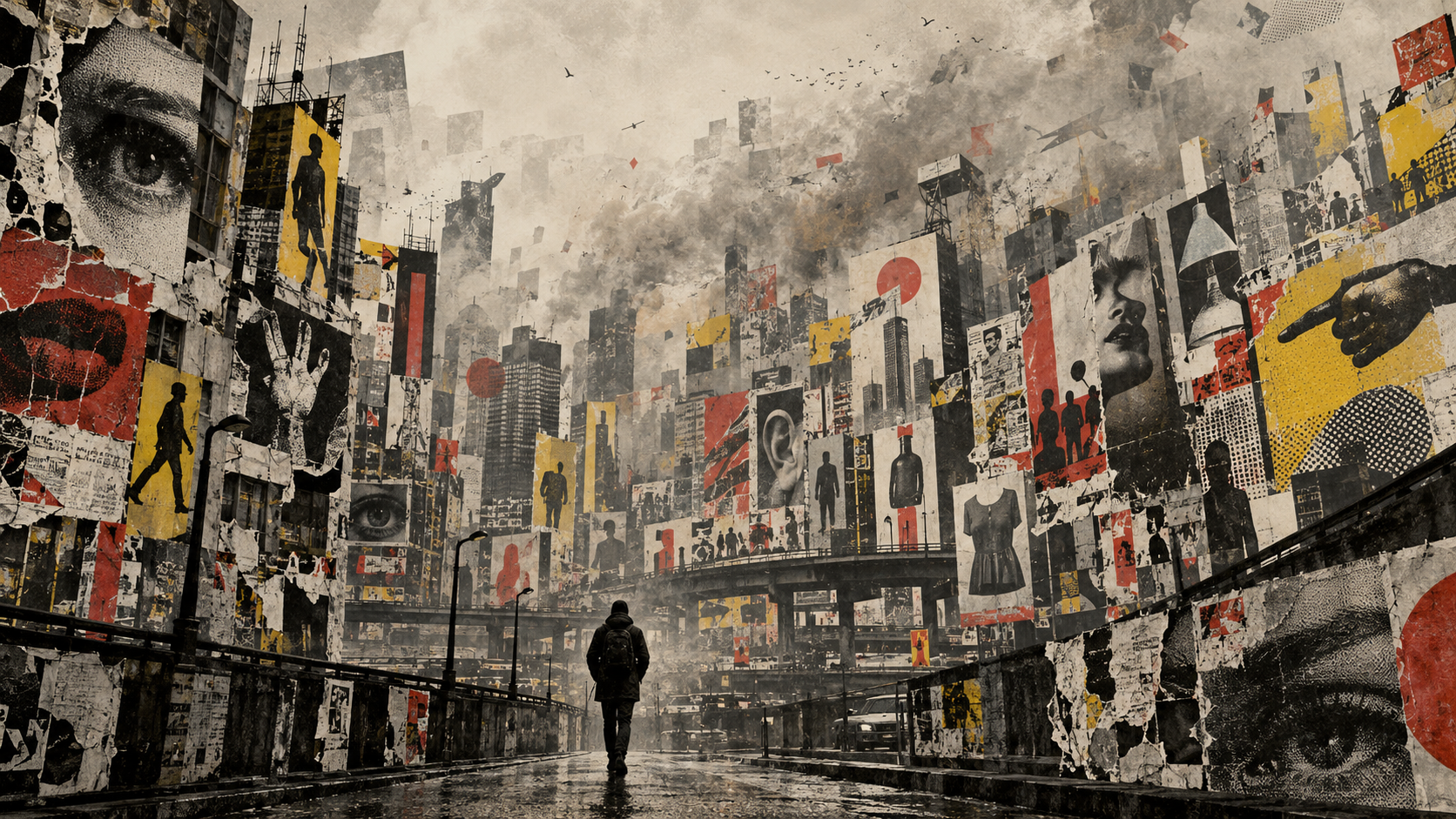
What does advertising leave behind?
Every advertisement makes a withdrawal from culture. It takes a little attention. A few seconds of a life. A patch of visual space. A place in memory.
It also makes a deposit. It leaves behind an image, an aspiration, a value, a joke, a fear, a stereotype, a possibility, a piece of meaning.
Is the deposit worth the withdrawal?
Because pollution begins when something takes more from an environment than it gives back.
A factory extracts resources and returns waste.
A car burns fuel and returns exhaust.
A plastic bottle is used for minutes and can remain in the environment for centuries.
Advertising extracts attention.
At its best, it gives us something valuable in return. Entertainment. Beauty. Usefulness. Language. Stories. Characters. Ideas. It creates symbols people can use and meaning people can share. Sometimes it produces something valuable enough to escape advertising altogether and become part of culture.
At its worst, it leaves nothing. No meaning. No memory. Or feeling. Just another interruption.
This is cultural pollution.
The cumulative damage caused when commercial messages take more from culture than they give back.
Culture is not an empty space waiting for brands to fill it.
It is an environment already saturated with meaning.
The things we notice.
The stories we tell.
The identities we perform.
The rituals we repeat.
The behaviours we normalise.
The ideas we share about success, beauty, status and the good life.
Advertising enters this environment and changes it.
It uses one cultural resource—attention—to influence another—meaning.
The problem is that marketing measures one side of this exchange far more closely than the other.
We measure what advertising does for the advertiser.
Impressions. Clicks. Conversions. Sales. Return on investment. CLV.
We rarely measure what billions of advertisements collectively do to everyone else.
The interruption. The mental effort. The commercial use of shared space. The repeated images of particular lifestyles, bodies and definitions of success. The gradual replacement of meaning with messages designed only to provoke an immediate response.
Cultural pollution is what happens when advertising ignores what it leaves behind.
One forgettable advertisement makes little difference. One intrusive notification does not destroy our ability to concentrate. And one empty piece of content does not make culture any less meaningful.
The damage builds over time.
Just as no single exhaust pipe creates the smog, no single six-second video creates the attention economy.
But billions of individually rational decisions can produce a collectively irrational result—a world overflowing with empty communication and starving for meaning.
Cultural pollution takes different forms.
-
Every commercial message demands the same—Notice me.
Attention, like time, is one of our most precious non-renewal resources.
And it’s the one thing millions of organisations look to capture, buy, optimise and retarget.
-
Advertising fills space with images, language and ideas—and much of what we produce has almost no ambition beyond getting a response.
SALE.
SHOP NOW.
TRY FREE.
DON’T MISS OUT.
LIMITED TIME ONLY.Billions of messages. Almost nothing being said.
The problem is not just too much communication. It is too much disposable communication.
Campaigns made from familiar trends, borrowed interest, generic emotion and the same bland visual language.
Work containing every signal of significance without creating any actual significance.
-
Advertising repeatedly shows us versions of the world.
Who leads.
Who cares.
Who desires whom.
Whose bodies count as beautiful.
What success looks like.
What happiness requires.Advertising does not need to persuade us of a worldview to reinforce it.
It merely needs to keep showing it to us.
Representations become expectations. Expectations become norms. And norms become hardest to see when they start to feel natural.
-
Advertising occupies our streets, train platforms, airports, sports stadiums, search results, social feeds, podcasts, inboxes, phone notifications and is making its way into our answer engines.
More of everyday life is being turned into commercial space.
Cultural pollution is not simply that advertising says too much.
It is that there are increasingly few places where commerce says nothing.
Dullness makes all of this worse.
The Extraordinary Cost of Dull research puts a commercial price on advertising that leaves people feeling nothing.
Its analysis estimated that the dullest 75% of US advertising would require an additional $189 billion in media investment to equal the commercial impact of the most engaging 25%.
That creates a strange cycle.
Dull advertising struggles to earn attention.
So brands buy more attention.
More media creates more exposure.
More exposure creates more pollution.
The work takes a little attention at a time.
But because it gives so little back, the system has to repeat the withdrawal again and again.
Dull advertising pollutes twice.
First, by consuming attention without leaving much meaning behind.
Then, by requiring even more advertising to compensate for its failure to connect.
This turns dullness from a creative problem into a cultural and commercial one.
It costs brands more to produce less value for everyone else.
It would be easy to blame all this on performance marketing.
But that would miss the point.
A useful search ad answering an immediate need may take less from culture than a giant brand campaign offering nothing in return. A beautifully made film can still reinforce damaging ideas. A sales message can be helpful. A brand message can pollute.
The real distinction is not between performance advertising and brand advertising.
It is between advertising that only takes and advertising that gives something back.
Performance marketing matters because of what it helped normalise, which is the relentless optimisation of whatever produces a measurable return whilst at the same time ignoring whatever falls outside the dashboard.
Clicks are measured.
Conversions are measured.
Acquisition costs are measured.
Cultural costs are not.
The advertiser captures the commercial gain.
The costs of interruption, repetition, imitation and intrusion are shared by everyone else.
This means cultural pollution does not require irresponsible people making deliberately harmful decisions.
It can be created by intelligent people making perfectly rational decisions inside a system that cannot see everything it produces.
And that system is about to become far more productive.
The machinery of modern marketing is already exceptionally good at making more.
More variations.
More placements.
More personalised messages.
More content for more audiences in more moments.
Generative AI will make that machinery faster still.
The cost of producing communication is collapsing. So is the cost of filling every available surface with it.
But efficiency only tells us how quickly and cheaply something can be produced.
It does not tell us whether that thing should exist.
When the cost of creating content approaches zero, restraint becomes more valuable—not less.
The scarce resource will not be content, but ideas worth paying attention to. Without those ideas, optimisation merely helps pollution travel further.
The answer is not silence.
The opposite of cultural pollution is cultural contribution.
A silly joke can contribute. So can a useful demonstration, a beautiful image, a distinctive character, a memorable phrase or a new representation.
Meaning does not need to be profound.
It can be entertaining, practical, emotional, social or symbolic.
It simply needs to reward attention with something more than the fact that a brand paid to appear.
The best brands understand this exchange.
They give people stories, symbols and language that travel beyond the ad. They create things people choose to remember, repeat, imitate and share.
They leave something behind after the media spend stops.
This is one reason some brands become more than products.
They accumulate cultural meaning.
Others spend just as much but leave almost no trace. Their campaigns create exposure without memory and content without consequence. When the media disappears, the brand disappears with it.
They occupy culture without becoming part of it.
Not every advertisement needs to transform culture.
But every brand asking for attention incurs a small debt. And that debt might be repaid with usefulness, entertainment, beauty, surprise, recognition or meaning—anything that makes the interruption feel like a fair exchange.
Beyond the typical measures of marketing performance, we should ask ourselves:
What did this brand put into culture in exchange for the attention it took out?
Because brands are not passive.
They repeat ideas. Reinforce norms. Create symbols. Give language to identity. Help shape what feels desirable, acceptable, valuable or possible.
Marketing is not merely a system for communicating products.
It is a system for shaping behaviour, culture and meaning.
That is its power.
Cultural pollution is what happens when we use that power without accounting for what we leave behind.